Lamb's Quarters Weed Control
If you're a gardener fighting lamb's quarters as a weed, you're dealing with one of the most persistent and prolific garden invaders. Here's how to identify it, remove it, and keep it from taking over.
What Is Lamb's Quarters Weed?
Lamb's quarters (Chenopodium album) is one of the most common garden weeds in North America and worldwide. It's a fast-growing annual that thrives in disturbed, fertile soil — exactly the conditions found in vegetable gardens, flower beds, and newly landscaped areas. A single plant can produce up to 70,000 seeds, and those seeds remain viable in the soil for 40+ years. This massive, long-lived seed bank is why it keeps coming back year after year.
Identifying It in Your Garden
Key features to look for (see our full identification guide for details):
- White, powdery/mealy coating on young leaves and growing tips (like flour dust)
- Diamond-shaped leaves with wavy, toothed edges
- Stems often with red or purple stripes
- Fast-growing — can go from seedling to 3+ feet in weeks
- Appears primarily in spring and summer in freshly disturbed soil
Why It's Hard to Control
- Massive seed production: 50,000–70,000 seeds per plant
- Long-lived seed bank: Seeds viable 40+ years in soil
- Continuous germination: New seedlings emerge throughout the growing season
- Fast growth: From seedling to seed-producing adult in as little as 6–8 weeks
- Adaptable: Tolerates a wide range of soil and light conditions
Organic Removal Methods
Hand-Pulling
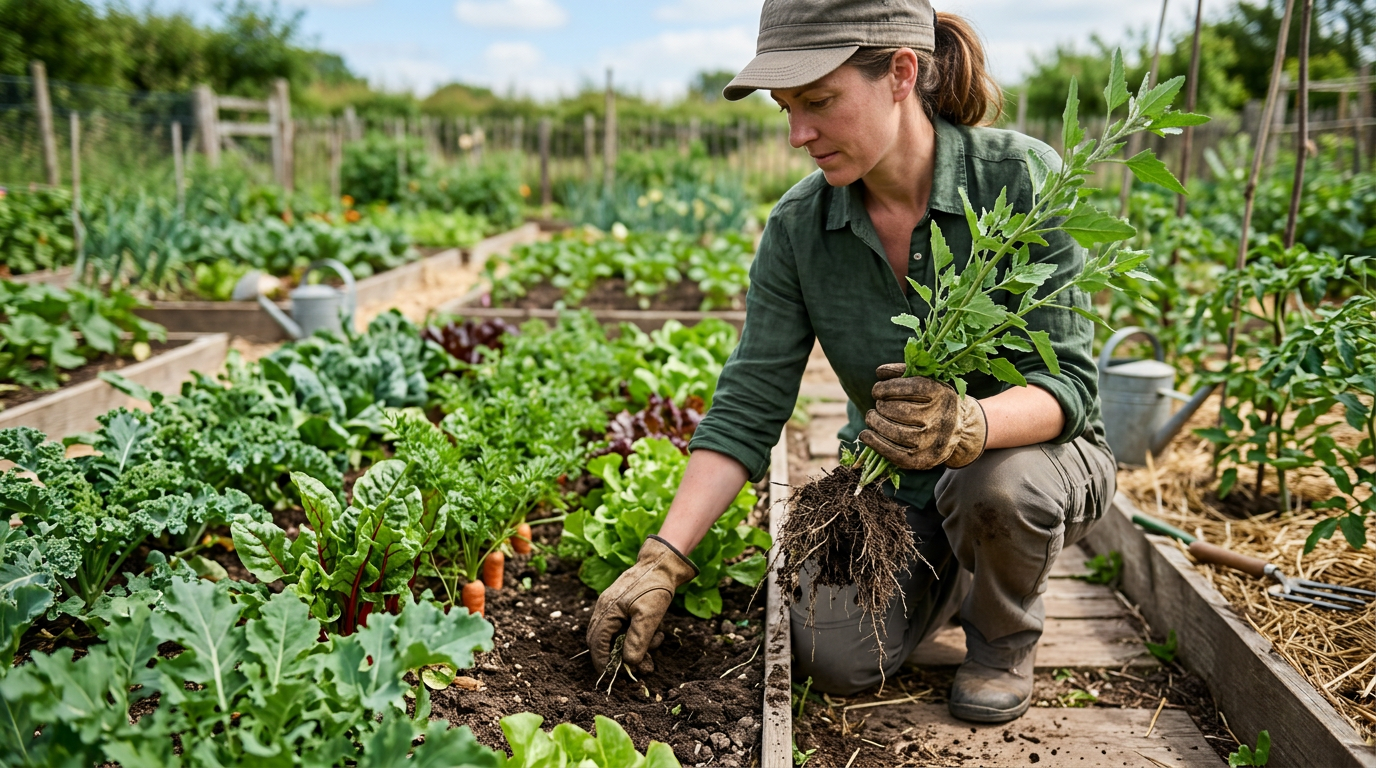
Most effective when plants are small (under 6 inches). Pull the entire plant including the taproot. Critical: pull BEFORE plants set seed. After rain is easiest, when soil is moist and roots come up cleanly.
Mulching
Apply 3–4 inches of organic mulch (straw, wood chips, shredded leaves) over garden beds. This prevents light from reaching seeds and suppresses germination. The most effective preventive measure for garden beds.
Cultivation / Hoeing
Use a sharp hoe to sever seedlings at or just below the soil surface. Most effective on young plants. Repeat every 2 weeks during the growing season. A stirrup hoe or collinear hoe works well for this.
Flame Weeding
Pass a propane torch briefly over young seedlings. The heat ruptures cell walls, killing the plant within hours. Effective for large areas and between rows. Use with extreme caution near dry materials.
Chemical Control
What Kills Lamb's Quarters?
For areas where organic methods aren't practical, several herbicide approaches are effective:
- Pre-emergent herbicides: Trifluralin (Treflan) and pendimethalin (Prowl) prevent seed germination when applied to soil before seeds sprout. This is the most effective chemical approach for large infestations.
- Glyphosate (Roundup): Yes, Roundup is effective on lamb's quarters. Apply to actively growing plants for best results. Glyphosate is non-selective (kills all plants it touches), so use carefully around desired vegetation.
- Broadleaf herbicides: Products containing 2,4-D or dicamba can selectively control lamb's quarters in grass/lawn areas without killing the grass. Check labels for specific crop safety.
Always follow herbicide label directions exactly. Avoid applying near food crops unless the label specifically permits it. Consider the environmental impact and try organic methods first.
Prevention: The Long Game
- #1 Rule: Don't let it set seed. This is the single most important thing you can do. One missed plant = 70,000 new seeds.
- Maintain consistent mulch coverage on all garden beds
- Cultivate or hoe regularly during the growing season
- Use landscape fabric in pathways and non-planted areas
- Be vigilant in spring when seedlings emerge — small plants are easy to remove
The Bright Side: It's Edible
Rather than spraying, consider eating it!
Lamb's quarters is one of the most nutritious wild greens available — higher in vitamins K, C, and A than cultivated spinach. Instead of fighting it, many gardeners harvest the young plants as a free, delicious vegetable. Check out our recipes and nutrition guide to turn your weed problem into dinner.
Frequently Asked Questions
What herbicide kills lamb's quarters?
Several herbicides are effective. Pre-emergent herbicides like trifluralin (Treflan) and pendimethalin (Prowl) prevent germination when applied before seeds sprout. Post-emergent options include glyphosate (Roundup), which kills the plant systemically, and broadleaf-selective herbicides like 2,4-D and dicamba for lawn areas. Always read and follow label directions, especially regarding application near food crops.
Does Roundup work on lamb's quarters?
Yes, glyphosate (the active ingredient in Roundup) is effective on lamb's quarters. Apply when plants are actively growing and before they set seed for best results. Glyphosate is non-selective, meaning it will kill any plant it contacts, so use carefully around desired plants. Multiple applications may be needed because the seed bank continues producing new plants throughout the season.
How do I stop lamb's quarters from coming back?
The most critical step is preventing seed production — never let plants flower and set seed, because one plant can produce 70,000 seeds that survive 40+ years in the soil. Combine regular removal (hand-pulling or hoeing every 2 weeks), 3–4 inches of mulch to suppress germination, and pre-emergent herbicides for large areas. Persistent effort over several years will gradually deplete the seed bank.