Lamb's Quarters Seeds
Lamb's quarters seeds are tiny, incredibly prolific, and — here's the exciting part — edible and nutritious. They're related to quinoa and have been used as a grain for thousands of years.
Seed Description
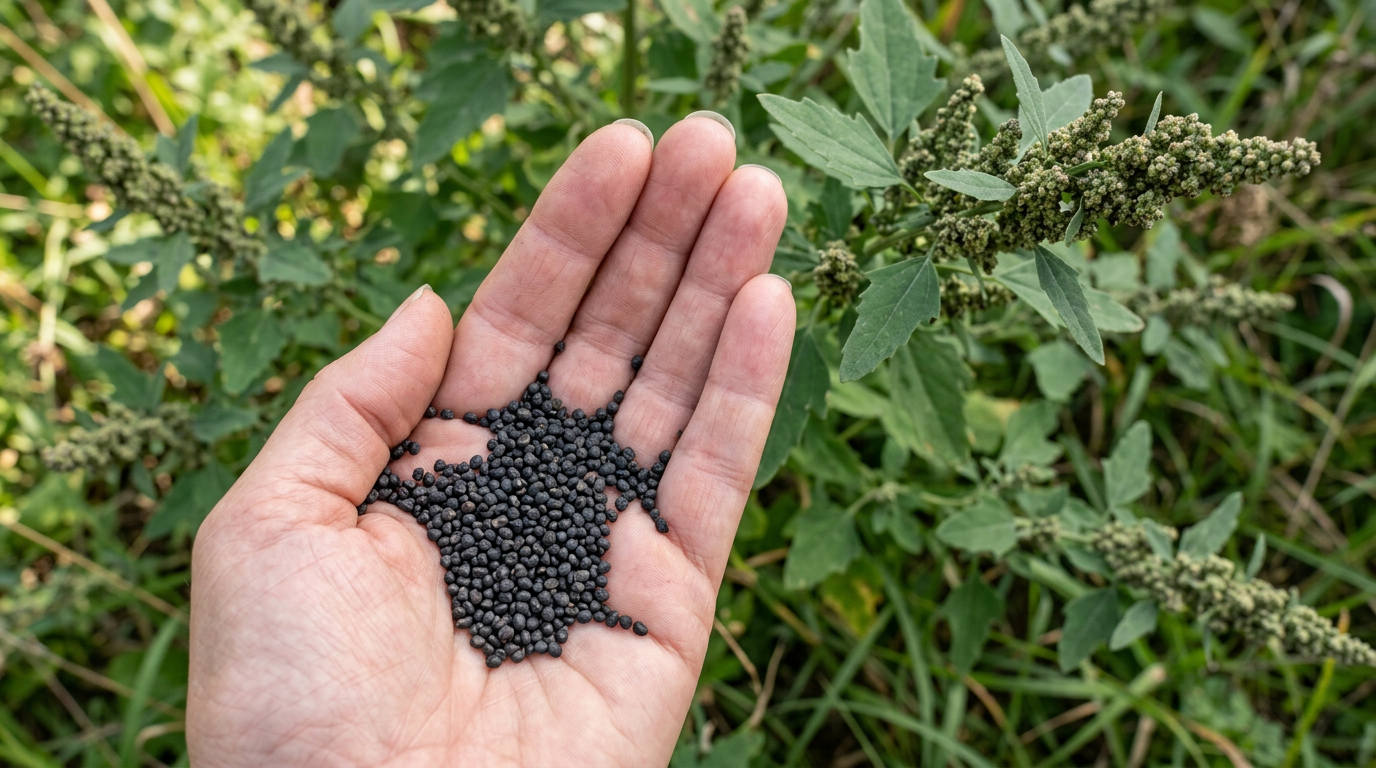
Lamb's quarters seeds are remarkably small — roughly 1–1.5mm in diameter, lens-shaped (lenticular), and dark brown to black with a shiny surface. They're produced in staggering quantities: a single mature plant can produce 50,000 to 70,000 seeds. The seeds form in dense clusters along the flowering spikes and mature from late summer through fall.
Are Lamb's Quarters Seeds Edible?
Yes! Lamb's quarters seeds have been eaten by humans for at least 10,000 years. Archaeological evidence shows they were a staple food for many Native American peoples and prehistoric European cultures. The seeds can be:
- Ground into flour for flatbreads and porridge
- Cooked whole like tiny grain (similar to amaranth)
- Sprouted for fresh greens
- Added to baked goods, soups, and cereals
Quinoa connection: Lamb's quarters (Chenopodium album) is in the same genus as quinoa (Chenopodium quinoa). Both produce protein-rich seeds. Lamb's quarters seeds are smaller but share a similar nutritional profile.
Seed Nutrition
Lamb's quarters seeds are nutritional powerhouses:
- Protein: Up to 16% protein content — comparable to quinoa and higher than most grains
- Complete amino acid profile: Contains all essential amino acids
- Rich in fiber, iron, and calcium
- Gluten-free: Suitable for those avoiding wheat and gluten
How to Harvest Seeds
Seed harvesting is best done in late summer to early fall (August–October in most regions):
- Wait for ripeness: Seeds are ready when they fall freely from the stalks when rubbed. The seed heads will look dry and straw-colored.
- Cut seed heads: Cut or break off entire seed head clusters into a paper bag or bucket
- Dry further: Spread seed heads on a tarp or screen in a dry, well-ventilated area for a few days if needed
- Thresh: Rub dried seed heads between your hands over a tarp or large bowl to release seeds
- Winnow: Pour seeds between two containers in a gentle breeze (or in front of a fan) to separate chaff from seeds. The heavier seeds fall; the lighter chaff blows away.
- Store: Place cleaned seeds in an airtight container in a cool, dry place. They remain viable for years.
Where to Buy Lamb's Quarters Seeds
If you want to intentionally grow lamb's quarters (rather than just letting it volunteer in your garden), seeds are available from several sources:
- Specialty seed companies: Baker Creek, Strictly Medicinal Seeds, and other heirloom/rare seed suppliers often carry Chenopodium album
- Online marketplaces: Etsy has multiple sellers offering lamb's quarters seeds
- Seed libraries: Local seed libraries and seed swaps often include it
- Foraging groups: Connect with local foragers who may share seeds
Look for listings under "Chenopodium album seeds," "lamb's quarters seeds," or "fat hen seeds." Both straight species and occasionally improved cultivars (like "Magenta Spreen," a purple variety) are available. Many foragers simply let existing plants go to seed and collect their own.
Growing From Seed
Growing lamb's quarters is remarkably easy — this is a plant that wants to grow:
- When to sow: Direct sow outdoors after the last frost, or scatter seeds in fall for spring germination. Seeds can also be started indoors 4–6 weeks before last frost.
- Germination: 7–14 days at 60–75°F (15–24°C). Seeds need light to germinate — press into soil surface, do not bury.
- Spacing: Thin to 12–18 inches apart for large plants, or grow more densely for a cut-and-come-again bed.
- Soil: Prefers fertile, disturbed soil but tolerates poor, compacted, or sandy soil remarkably well.
- Self-seeding: Once established, lamb's quarters self-seeds prolifically. One planting creates a perpetual patch.
For a complete growing guide including zones, soil, and care, see our growing guide. To learn what seedlings look like so you can identify volunteers, see our identification guide.
Frequently Asked Questions
Can you save lamb's quarters seeds?
Yes! Wait until late summer or early fall when the seed heads are dry and seeds fall freely when you rub the stalks. Cut entire seed heads, dry them further indoors if needed, then thresh by rubbing between your hands over a tarp or bowl. Winnow by pouring seeds between two containers in a gentle breeze to remove chaff. Store in an airtight container in a cool, dry place. Seeds remain viable for years.
How do you grow lamb's quarters from seed?
Direct sow seeds outdoors after the last frost (or in fall for spring germination). Scatter seeds on the soil surface and press lightly — they need light to germinate. Keep moist until germination (7–14 days at 60–75°F). Thin seedlings to 12–18 inches apart. That's essentially it — lamb's quarters is one of the easiest plants to grow, requiring minimal care once established.