Lamb's Quarters Identification
A complete visual guide to identifying lamb's quarters (Chenopodium album) from seedling to seed. Whether you're foraging, weeding, or just curious, here's how to know it when you see it.
Seedling Stage
Lamb's quarters seedlings emerge with two elongated, oval cotyledons (seed leaves) that have a distinctive blue-green color. Within days, the first true leaves appear — small, diamond-shaped leaves with irregular wavy teeth along the margins. Even at this tiny stage, you can often see the beginnings of the plant's signature white mealy coating on the upper surface of the true leaves.
Seedlings are typically 1–3 inches tall with thin, upright stems. They're most commonly found in spring (March–May) in disturbed soil — freshly turned garden beds, compost piles, and field edges are prime spots. A single mother plant can produce tens of thousands of seeds, so you'll often find dense clusters of seedlings.
Young Plant (Vegetative Stage)
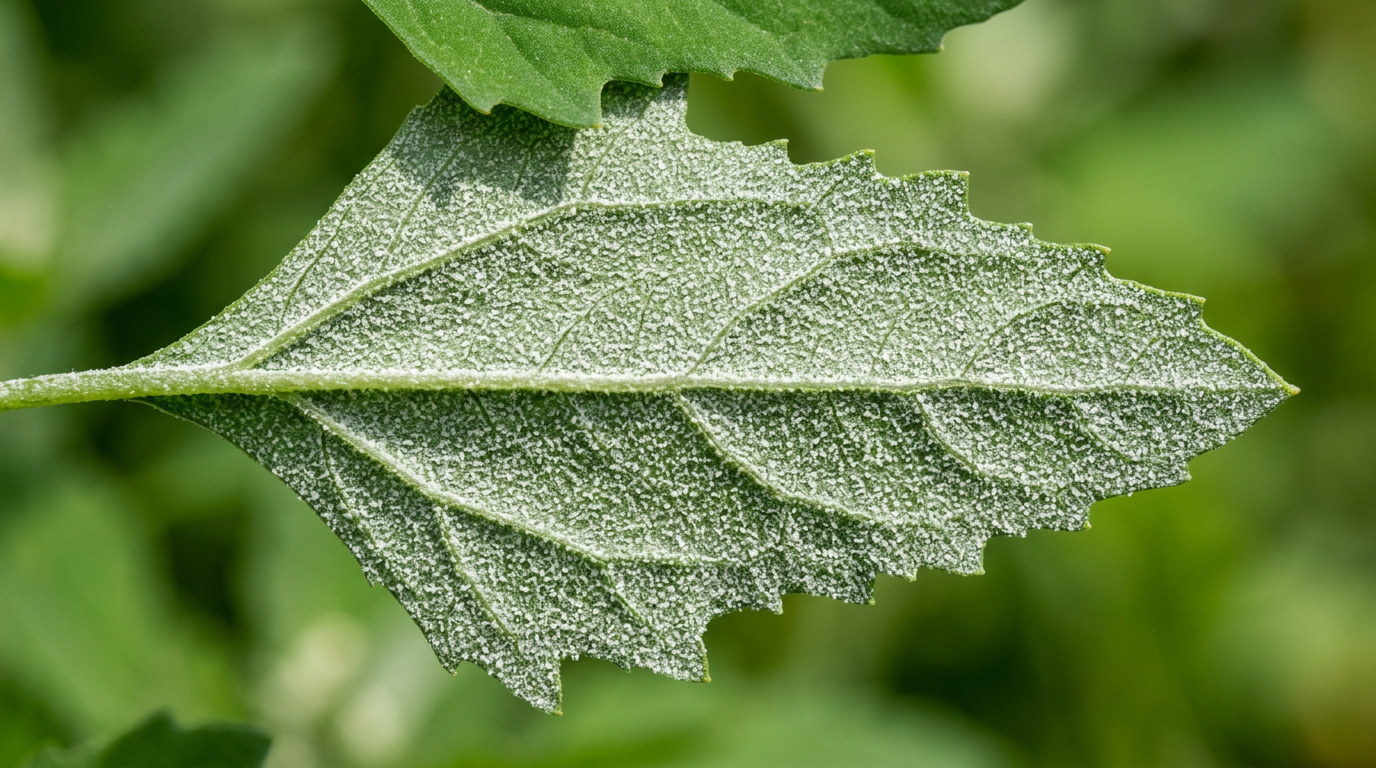
As the plant grows to 6–18 inches, its defining characteristics become unmistakable. The mealy white coating — technically called a farinose coating — is the single most important identification feature. Young leaves and the growing tips look as though they've been lightly dusted with white flour. This coating is made up of tiny bladder cells (vesicular trichomes) that are water-repellent. Rub a young leaf between your fingers and you'll feel the waxy, almost talc-like texture. No common look-alike shares this feature.
Leaves at this stage are 1–3 inches long, alternate (one per node on the stem), petiolate (with a stem), and distinctly diamond-shaped to rhombic with wavy, toothed margins. The upper surface is green with mealy coating; the underside is paler and even more heavily coated in white.
Stems begin to branch and often develop reddish or purple stripes, particularly at the nodes and lower portions of the plant. This is more pronounced in some individuals and growing conditions.
Mature Plant
Mature lamb's quarters plants are substantial — typically 2–4 feet tall in most garden settings, though they can reach 6 feet or more in rich, moist soil with full sun. The plant develops a bushy, branching growth habit with a strong central stem.
Key mature features:
- Height: 1–6 feet (commonly 2–4 feet in gardens)
- Stems: Branched, often with prominent red/purple stripes; grooved surface; can become woody at the base
- Leaves: Alternate, diamond-rhombic; upper leaves become narrower and more lance-shaped toward the top; mealy coating less pronounced on older leaves
- Root system: Taproot with fibrous lateral roots; pulls up fairly easily when young but anchors firmly in older plants
Flowering Stage
From July through September, lamb's quarters produces tiny, inconspicuous green flowers in dense, spike-like clusters (panicles) at the tips of stems and branches. The flowers have no petals — just small greenish sepals. The plant is monoecious, meaning each plant has both male and female flowers. The flower clusters are often mealy-coated as well, giving them a frosted appearance.
During flowering, the leaves become tougher and less palatable for eating. Foragers generally prefer to harvest before this stage.
Seeds & Late Season
After pollination, each tiny flower produces a single small seed — lens-shaped, about 1–1.5mm in diameter, and dark brown to black with a shiny surface. A single mature plant can produce an astounding 50,000 to 70,000 seeds. The seeds remain viable in the soil for 40+ years, which is why lamb's quarters is such a persistent garden presence.
In late season, stems take on deeper reddish-purple tones, leaves become tough and sometimes yellow, and the seed heads dry to a straw color. Seeds can be harvested for use as a grain — see our seeds guide for details.
Purple Lamb's Quarters
You may encounter plants with distinctly reddish-purple leaves and stems. This is typically Chenopodium berlandieri var. sinuatum (or closely related varieties), sometimes called purple lamb's quarters or magenta spreen. It's also edible and nutritious — the purple color comes from anthocyanin pigments, the same compounds that make blueberries blue.
Regular lamb's quarters can also develop purple spots or patches on its leaves, especially under stress conditions (cold snaps, nutrient changes, or strong sunlight). This is normal and doesn't indicate any problem with the plant.
Leaf Details
The lamb's quarters leaf is the key to identification. Here's what to examine:
- Shape: Diamond-shaped to rhombic (wider in the middle, pointed at tip and base); upper leaves may be narrower and more lance-shaped
- Margins: Irregularly wavy-toothed (sinuate-dentate); not deeply lobed
- Arrangement: Alternate on the stem (one leaf per node)
- Surface: Upper side green with mealy coating; underside paler with heavier mealy coating
- Petiole: Each leaf has a distinct stem (petiole) attaching it to the main stem
- Size: 1–4 inches long depending on plant age and position
Habitat & Where to Look
Lamb's quarters is a plant of disturbed soil. You'll find it in garden beds, compost heaps, field margins, roadsides, vacant lots, construction sites, and agricultural fields. It's an indicator of nitrogen-rich, fertile soil. For detailed growing information, see our growing guide.
Distinguishing From Look-Alikes
While lamb's quarters is one of the safer wild plants to identify (thanks to the unique mealy coating), several plants are sometimes confused with it. The key comparisons include pigweed (Amaranthus), black nightshade (Solanum nigrum), other goosefoot species, and the completely unrelated lamb's ear (Stachys byzantina). For a detailed side-by-side comparison, see our complete look-alikes guide.
Frequently Asked Questions
What does a young lambs quarter seedling look like?
Young lamb's quarters seedlings have elongated, oval cotyledons (seed leaves) with a blue-green tint. The first true leaves are small, diamond-shaped, and develop the characteristic white mealy coating almost immediately. Seedlings are often less than 2 inches tall and can be confused with other weedy seedlings, but the mealy coating sets them apart even at this early stage.
How tall does lamb's quarters get?
Lamb's quarters typically grows 1 to 6 feet tall, with most garden specimens reaching 2 to 4 feet. In ideal conditions — rich soil, full sun, and adequate moisture — plants can exceed 6 feet. The plant's height depends heavily on soil fertility, available space, and when it germinates in the season.
What are those white spots on lamb's quarters leaves?
The white spots or coating on lamb's quarters leaves are not spots at all — they are a natural mealy or farinose coating made up of tiny bladder-shaped trichomes (specialized cells) that are filled with water and collapse to create the powdery appearance. This coating is the single most reliable identifying feature of the plant. It makes the leaves water-repellent and is thought to help the plant regulate water loss and reflect excess sunlight.