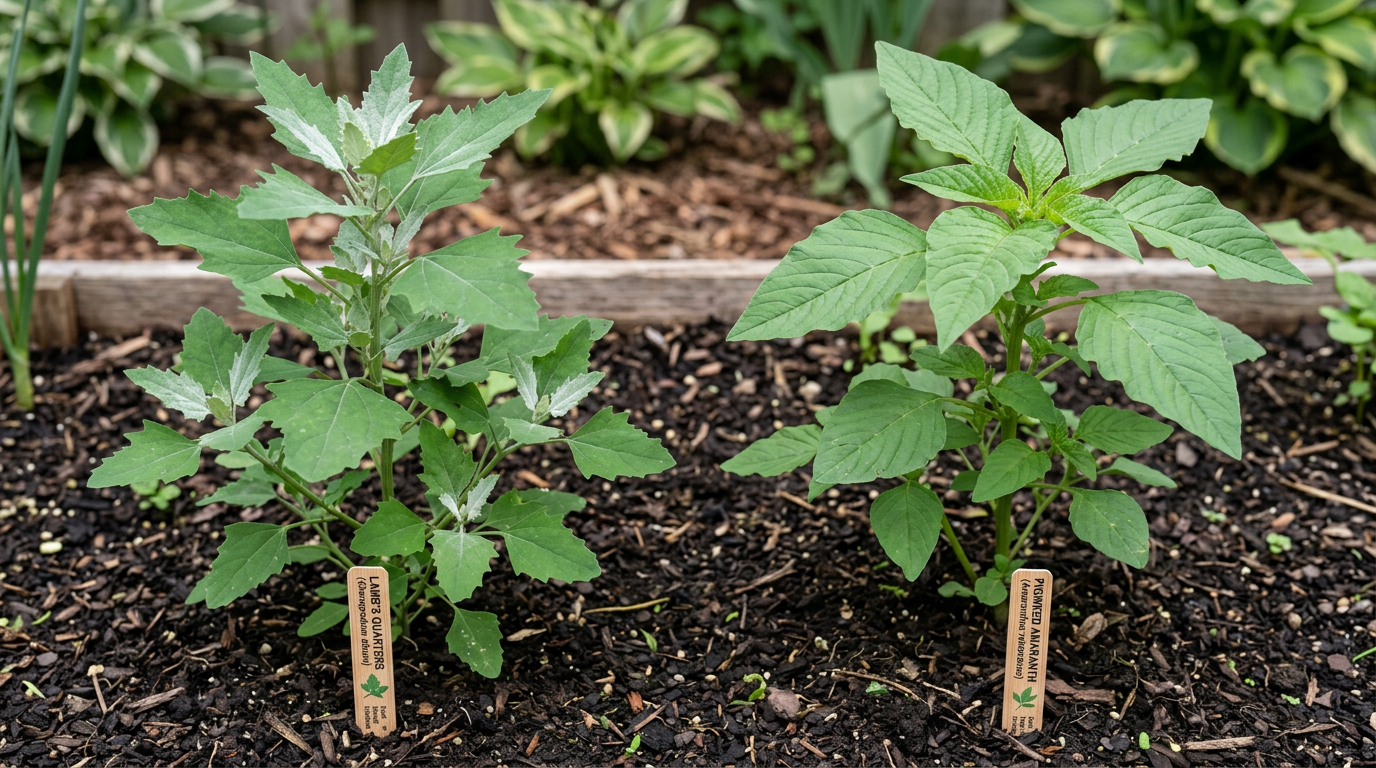
Lamb's Quarters Look-Alikes
Lamb's quarters is generally one of the safer wild plants to identify, thanks to its distinctive white mealy coating. But several plants are sometimes confused with it. Here's how to tell them apart.
The Mealy Coating: Your Best Friend
Before we compare individual species, remember this: the white, powdery, mealy coating on lamb's quarters leaves and growing tips is the single most reliable feature separating it from all common look-alikes. Rub a young lamb's quarters leaf between your fingers — the waxy, flour-like mealiness is unique to Chenopodium. If a plant has this coating, it's almost certainly a lamb's quarters or closely related (and also edible) goosefoot species.
If a plant does not have this mealy coating, proceed with extra caution before eating it. See our identification guide for detailed photos and descriptions.
Comparison Table
| Plant | Edible? | Key Differences from Lamb's Quarters | Safety |
|---|---|---|---|
| Lamb's Quarters Chenopodium album | Yes — leaves & seeds | White mealy coating (definitive); diamond-shaped toothed leaves; smooth stems with purple stripes; tiny green flower clusters | Safe. Both leaves and seeds widely eaten worldwide. |
| Pigweed / Amaranth Amaranthus retroflexus | Yes — leaves & seeds | NO mealy coating; rougher, hairy texture; more oval/egg-shaped leaves; bristly reddish flower spikes; stems often hairy/rough | Safe. Can accumulate nitrates in drought — cook before eating in large amounts. |
| Black Nightshade Solanum nigrum | Caution — toxic parts | NO mealy coating at all; smooth, oval leaves; small white star-shaped flowers; round berries (green→black); completely different leaf shape | Unripe berries & plant parts contain solanine (toxic). Do NOT eat unless expert-confirmed. |
| Other Goosefoot spp. Chenopodium spp. | Generally yes | Very similar appearance; some species have less mealy coating; subtle leaf shape differences; same general growth habit | Most Chenopodium species are edible. Treat like lamb's quarters. |
| Jewelweed Impatiens capensis | Not typically eaten | Completely different: translucent succulent stems; orange trumpet flowers; grows in wet/shady areas; no resemblance at close inspection | Used medicinally for poison ivy. Not a true look-alike — confusion only from casual/distant viewing. |
| Lamb's Ear Stachys byzantina | Not a food plant | Completely different plant: fuzzy/woolly silver leaves (like felt); low rosette growth; purple flower spikes; ornamental garden plant | Confusion is in the NAME only. The plants look nothing alike. |
Detailed Comparisons
Lamb's Quarters vs. Pigweed (Amaranth)
This is the most common confusion. Both are extremely common garden weeds, both are edible, and they often grow side by side. The key differences:
- Mealy coating: Lamb's quarters has it; pigweed does not
- Leaf texture: Lamb's quarters leaves are smooth; pigweed leaves are rougher with a slightly hairy feel
- Leaf shape: Lamb's quarters leaves are diamond-shaped; pigweed leaves are more oval/egg-shaped with a rounded tip
- Flowers: Lamb's quarters has small green clusters; pigweed has distinctive bristly, dense, reddish-green flower spikes
- Stems: Lamb's quarters stems are smooth with purple stripes; pigweed stems are often hairy/rough, especially when young
The good news: both plants are edible and nutritious, so even if you mix them up, you're safe.
Lamb's Quarters vs. Black Nightshade
This is the comparison that matters most for safety. Black nightshade (Solanum nigrum) contains solanine in its unripe berries and plant parts.
- Mealy coating: Lamb's quarters has the mealy coating; nightshade has NONE — leaves are completely smooth and glossy
- Berries: Nightshade produces distinctive round berries (green turning to black when ripe); lamb's quarters never produces berries of any kind
- Flowers: Nightshade has small white star-shaped flowers with yellow centers (typical Solanum); lamb's quarters flowers are tiny, green, and inconspicuous
- Leaf shape: Nightshade leaves are more oval/heart-shaped with smooth or gently wavy edges; lamb's quarters leaves are distinctly diamond-shaped with toothed margins
Safety rule: If a plant has round berries of any color, it is NOT lamb's quarters. Do not eat it unless you are certain of its identity.
Lamb's Quarters vs. Lamb's Ear
Despite the similar names, these plants look nothing alike. Lamb's ear (Stachys byzantina) is a popular ornamental garden plant with thick, fuzzy, silvery-white leaves that feel like soft velvet or felt. It grows as a low rosette and produces purple flower spikes. Lamb's quarters has smooth (not fuzzy) green leaves with mealy coating, grows upright to several feet tall, and has an entirely different growth form. The confusion is purely in the names.
Allergy Note
Some people are allergic to Chenopodium pollen, which is airborne during the flowering period (July–September). Additionally, those with known sensitivities to spinach or beets (which are in related plant families) may experience cross-reactions with lamb's quarters. If you have known allergies to these foods, start with a small taste and watch for any reaction.
Frequently Asked Questions
Is lamb's quarters the same as pigweed?
No, though the name 'pigweed' is sometimes informally applied to both plants. True pigweed is Amaranthus retroflexus (redroot pigweed) — a different genus and family. Pigweed lacks the white mealy coating, has rougher/hairy texture, more oval leaves, and produces bristly reddish flower spikes. Both are edible, but they are distinct species.
Can you confuse lamb's quarters with nightshade?
It's possible at a quick glance, but close inspection reveals major differences. Black nightshade (Solanum nigrum) has completely smooth leaves with NO mealy coating, produces distinctive round berries (green turning black), and has a different leaf shape (more oval with smooth or slightly wavy edges). Nightshade berries when unripe are toxic. Always check for the mealy coating — if it's there, it's not nightshade.
What plant looks most like lamb's quarters?
Other Chenopodium species (goosefoot family members) look the most similar, as they share the same general growth habit and sometimes the mealy coating. These include Chenopodium berlandieri (pitseed goosefoot) and Chenopodium murale (nettle-leaved goosefoot). The good news is that most Chenopodium species are also edible, so a mix-up within the genus is generally safe.