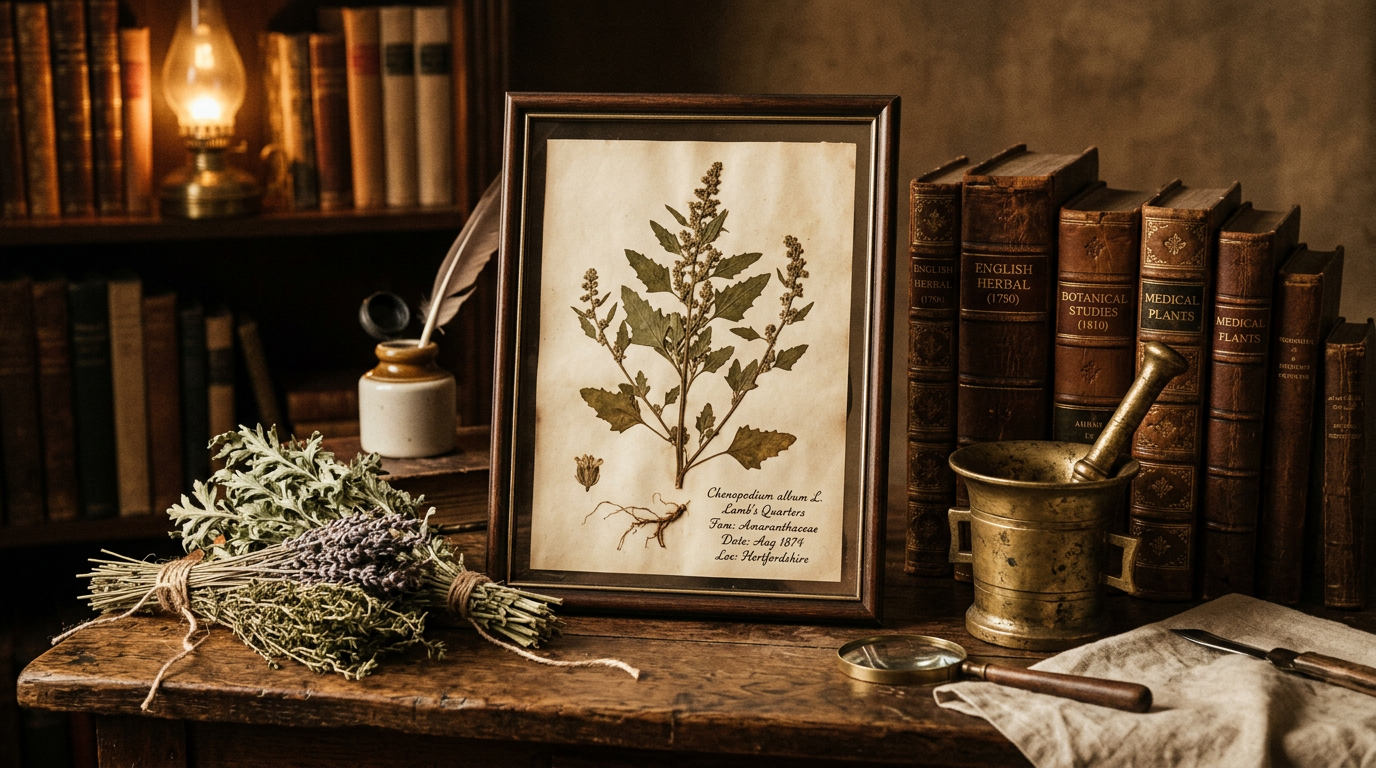
History & Culture of Lamb's Quarters
Lamb's quarters isn't just a common weed — it's one of humanity's oldest food plants, with a cultural footprint that spans continents and millennia. From Iron Age Europe to modern-day India, this plant has nourished people for at least 10,000 years.
Ancient History
Archaeological evidence places Chenopodium use deep in human prehistory. Seeds have been found in Neolithic and Iron Age sites across Europe and the Americas, often in quantities suggesting deliberate cultivation or large-scale harvesting. In the Americas, Chenopodium berlandieri (a close relative) was one of the earliest domesticated plants, predating the arrival of maize in many regions.
Before quinoa became a global superfood, its ancestor and cousin — lamb's quarters — was feeding civilizations. The Chenopodium genus has been a staple food source on every inhabited continent for thousands of years.
Native American Use
Indigenous peoples of North America used lamb's quarters extensively. The Cherokee, Iroquois, Navajo, Blackfoot, and many other nations harvested both the leaves (as greens) and seeds (as grain). Archaeological sites across the eastern United States show that Chenopodium seeds were a major food source — ground into meal for flatbreads, porridge, and mixed with other grains.
Some scholars consider Chenopodium one of the "lost crops" of North America — plants that were under cultivation before European contact but were displaced by Old World crops like wheat and corn.
European History
In medieval and early modern Europe, lamb's quarters was a common peasant food, eaten as greens and with seeds used in times of grain scarcity. The English name "fat hen" dates to at least the 16th century — a reference to the plant's use as poultry feed (it fattened hens) and possibly to the plump, well-fed appearance of the plant itself.
European herbals from the 1500s onwards describe the plant's food and medicinal uses. It was a staple of cottage gardens and field edges long before modern agriculture made it purely a weed in most people's eyes.
The Name "Lamb's Quarters"
The origin of the name is debated among etymologists:
- Lammas + quarter: Possibly from "Lammas quarter" — Lammas (August 1) being an early harvest festival in England, and the plant reaching peak size around that time
- Lamb + quarter: The lobed leaf shape may have been compared to a leg or quarter of lamb
- Lambsquarter as a single word: May derive from older English or Germanic terms for the plant that were later reinterpreted
Whatever the true origin, both "lamb's quarters" (possessive plural) and "lambs quarter" (without apostrophe, singular) are widely used. Both are correct in common usage.
Fat Hen (UK Name)
Throughout the United Kingdom and parts of Commonwealth countries, Chenopodium album is most commonly known as "fat hen." The name likely references its historical use as poultry feed — chickens fed on the nutrient-rich plant would fatten quickly. Some scholars suggest the name may alternatively refer to the plump, full seed heads of the mature plant, or the general abundance and "well-fed" look of the plant itself.
Bible References
Some scholars and folk herbalists have connected lamb's quarters to the "bitter herbs" mentioned in the Bible (Exodus 12:8, Numbers 9:11). The Israelites were instructed to eat the Passover lamb with bitter herbs, and various Chenopodium species are among the candidates for these ancient plants. While the exact species is debated (other candidates include endive, chicory, dandelion, and horseradish), the lamb's quarters connection persists in some folk traditions.
The name "lamb's quarters" itself has occasionally been given religious folk associations, with "lamb" interpreted as a reference to the Lamb of God, though this is likely a folk etymology rather than the actual origin.
Magical & Folk Properties
In various folk magic and herbalism traditions, lamb's quarters has been associated with:
- Prosperity and money: In some European and American folk practices, the plant was carried or used in rituals for financial success
- Protection: Dried plant material was sometimes hung in homes or carried for protection
- Luck: Some folk traditions consider finding a large specimen to be a sign of good fortune — practical, too, since its presence indicates fertile soil
- Fertility: The plant's prolific seed production led to associations with fertility and abundance in some folk practices
These folk associations are historical and cultural. They are not medical or scientific claims.
International Names
| Language/Region | Name(s) | Notes |
|---|---|---|
| English (UK) | Fat hen, white goosefoot | Most common UK name; reference to poultry fattening |
| Spanish | Quelite cenizo, cenizo, bledo blanco | Mexico/Latin America; "quelite" = edible wild green |
| Tagalog | Opoy, puting berde | Philippines; eaten as vegetable |
| Hindi | Bathua (बथुआ) | Major winter vegetable across South Asia |
| German | Weißer Gänsefuß | "White goosefoot" — reference to leaf shape |
| French | Chénopode blanc, ansérine blanche | "White goosefoot / goose plant" |
| Italian | Farinello comune | "Common floury one" — reference to mealy coating |
| Japanese | Shiroza (シロザ) | "White weed" |
| Chinese | Hui tiao cai (灰条菜) | Eaten as vegetable in some regions |
Bathua: South Asian Significance
In South Asia, lamb's quarters (known as bathua in Hindi/Urdu) is not a weed — it's a beloved winter vegetable. Across India, Pakistan, and Bangladesh, bathua is a staple of winter cooking:
- Bathua saag: Cooked greens, often with mustard greens, garlic, and spices
- Bathua raita: A classic side dish of blanched bathua mixed with yogurt and spices
- Bathua paratha: Flatbread stuffed with spiced bathua filling
- Bathua ka soup: Nutritious green soup flavored with cumin and ginger
Bathua is nutritionally prized in Ayurvedic tradition and is considered especially beneficial during winter months. It's sold in markets across northern India from November through March.
Frequently Asked Questions
Why is it called lamb's quarters?
The exact origin is debated. Leading theories include: a corruption of "Lammas quarter" (Lammas being the August harvest festival when the plant is at peak size), a reference to the leaf shape resembling a quarter/leg of lamb, or derivation from an older English/Germanic plant name. Both "lamb's quarters" and "lambs quarter" are widely used.
What is fat hen plant?
Fat hen is the common UK/British name for Chenopodium album — the same plant known as lamb's quarters in North America. The name likely references its historical use as poultry feed or the plump appearance of its seed heads. It's one of the most common arable weeds in Britain and has been eaten there for centuries.
What is lamb's quarters called in Spanish?
In Mexico and Latin America, it's most commonly called "quelite cenizo" or just "cenizo" (meaning "ashen" for its grey-green color). Other Spanish names include "bledo blanco" and "armuelle blanco." The term "quelite" is a Nahuatl-derived word meaning edible wild green and encompasses several species.