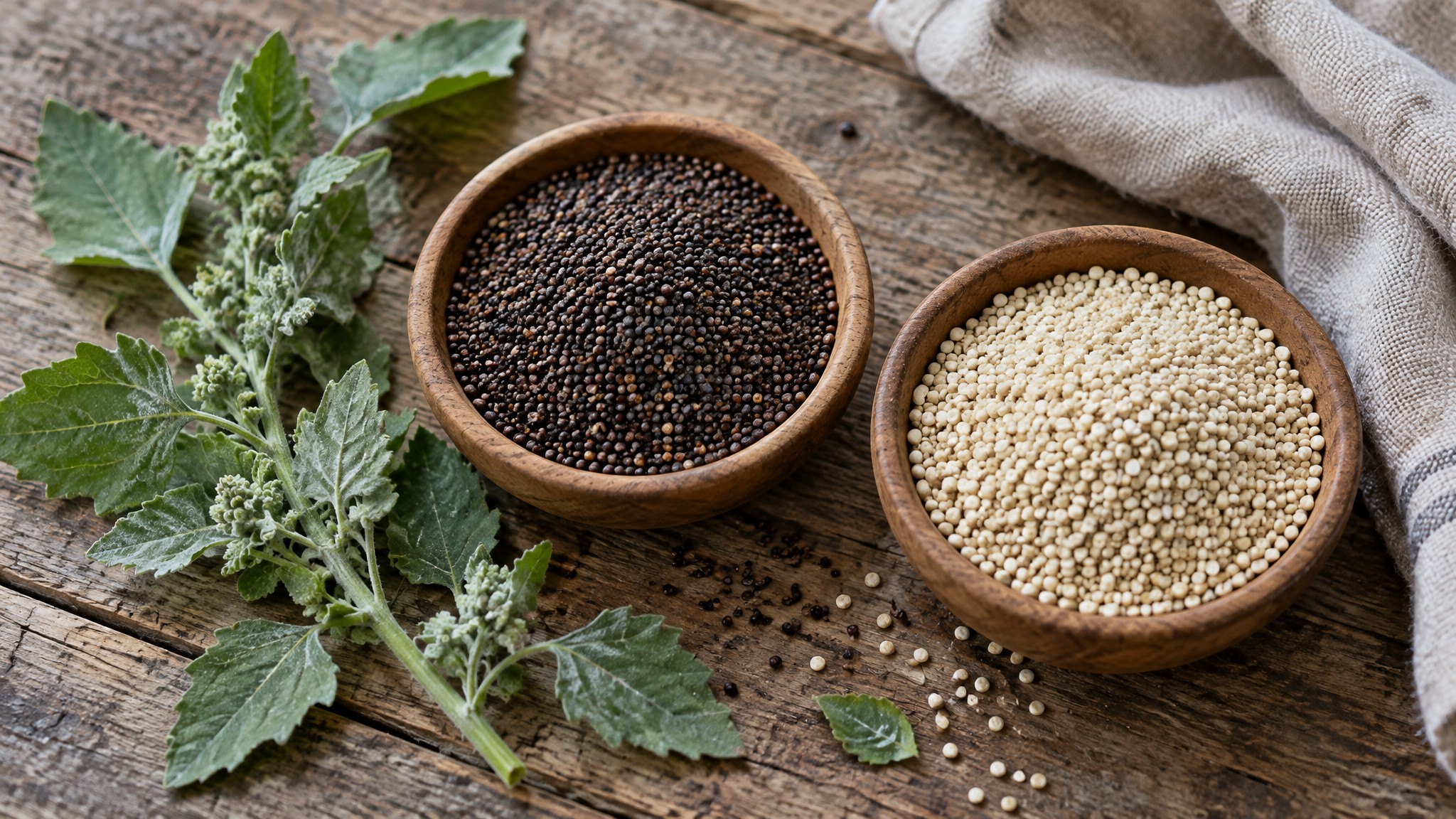
Lamb's Quarters vs Quinoa: The Nutritional Showdown
One is a global superfood with a premium price tag. The other grows as a weed in your garden and gets pulled up by the handful. They are close cousins — and the comparison is more interesting than you would expect.
Close Cousins, Very Different Careers
Lamb's quarters and quinoa are both members of the genus Chenopodium, the goosefoots. Genetically and nutritionally they are near neighbours. What separates them is not biology but marketing and history.
Quinoa (Chenopodium quinoa) was domesticated in the Andes thousands of years ago and carefully bred for large, uniform, saponin-coated seeds that thresh cleanly. It is now a multi-billion-dollar export crop.
Lamb's quarters (Chenopodium album) was never fully domesticated. It was eaten enthusiastically across Europe and North America — the seeds were ground into flour, the leaves cooked as greens — but it remained a volunteer plant that followed human disturbance rather than a planted crop. Its seeds are tiny, dark, and awkward to harvest at scale. So it stayed a weed.
That accident of history is the entire reason one costs twelve dollars a pound and the other is something you pull out of a flowerbed.
Nutritional Comparison
The comparison below is not quite apples to apples, and it is worth being precise about why. The figures for lamb's quarters are for the leaves, which is how the plant is overwhelmingly eaten. Quinoa figures are for the cooked seed, which is how quinoa is eaten. They are different plant parts doing different jobs.
| Nutrient | Lamb's Quarters Leaves (100 g raw) | Quinoa (100 g cooked) |
|---|---|---|
| Calories | ~43 kcal | ~120 kcal |
| Protein | ~4.2 g | ~4.4 g |
| Carbohydrate | ~7.3 g | ~21 g |
| Fiber | ~4 g | ~2.8 g |
| Vitamin K | ~773 µg (very high) | Low |
| Vitamin C | ~80 mg | Negligible after cooking |
| Vitamin A | ~580 µg RAE | Negligible |
| Calcium | ~309 mg | ~17 mg |
| Iron | ~1.2 mg | ~1.5 mg |
| Magnesium | ~34 mg | ~64 mg |
The pattern is clear. Quinoa wins on calories, carbohydrate, and magnesium — it is an energy-dense grain, which is the point of a grain. Lamb's quarters wins decisively on vitamins and minerals, especially vitamin K, vitamin C, vitamin A, and calcium. It is a leafy green, and it performs like an outstanding one. Our full nutrition breakdown covers the complete profile, including the oxalate caveat that applies to both.
The Protein Question
Quinoa's fame rests largely on its protein: it contains all nine essential amino acids, making it an unusually complete plant protein. That reputation is deserved.
What is less well known is that lamb's quarters seeds are nutritionally similar — same genus, similar amino acid profile, protein content in the same range. The difference is that almost nobody eats them, because harvesting them at any scale is genuinely laborious. Each plant produces tens of thousands of seeds, but they are about a millimetre across and ripen unevenly.
If you are eating lamb's quarters for protein, you are eating the leaves, and the leaves deliver a respectable ~4.2 g per 100 g — high for a green, but not a protein source in the way a seed is. If you want the seed comparison, see our lamb's quarters seeds guide, which covers harvesting, winnowing, and how to use them.
Harvest and Preparation: Where They Really Diverge
This is the honest reason quinoa dominates the market.
- Quinoa: Plant a field, harvest with a combine, thresh mechanically, rinse off the saponins, cook in fifteen minutes. Industrial from end to end.
- Lamb's quarters leaves: Walk outside, pinch the top few inches off a plant, rinse, cook in three minutes. Faster than quinoa, but only in small quantities.
- Lamb's quarters seeds: Wait for late summer, cut the seed heads, dry them, rub them free, then winnow the chaff away by hand in the wind. Expect a modest yield for real effort.
So the practical split is this: lamb's quarters is a vegetable you can harvest in seconds, and quinoa is a grain you buy in a bag. Trying to substitute one for the other in the kitchen mostly does not work.
In the Kitchen
Quinoa cooks into distinct, slightly nutty, fluffy grains and works as a base for bowls, salads, and pilafs. It has a faintly soapy edge if you skip rinsing, which is the saponin coating.
Lamb's quarters cooks down like spinach — dramatically, so start with more than you think you need. The flavour is mild, green, and slightly earthy, with none of quinoa's nuttiness. Young leaves are excellent raw; larger leaves want a quick wilt. It substitutes directly for spinach, chard, or any mild cooking green. Our recipe collection has six ways to use it, from a three-minute sauté to a pesto that freezes well.
Which Should You Actually Eat?
Both, for different reasons.
Choose quinoa when you need calories, a grain base, a complete-protein seed, or something shelf-stable that keeps for months in the pantry.
Choose lamb's quarters when you want a leafy green with an exceptional vitamin and mineral profile, for free, growing within walking distance of most homes from spring through early summer. As a straight swap for spinach it is arguably better — more calcium, more vitamin C, more vitamin A.
And there is a historical irony worth appreciating. Lamb's quarters was a staple food across Europe and North America for centuries, and remains a major cultivated vegetable in South Asia as bathua. Quinoa was a staple in the Andes for millennia. Both were pushed aside — quinoa by colonial disruption, lamb's quarters by the rise of industrial agriculture and the reclassification of a food plant as a weed. Our history and culture guide traces how that happened, and why the plant is now making a quiet return.
The Bottom Line
Nutritionally, the leaves of lamb's quarters beat quinoa on vitamins and minerals; quinoa beats them on calories and carbohydrate. As seeds, the two are close relatives with similar protein profiles — one industrialized, one not. The real difference is not nutritional at all. It is that we decided to farm one and to spray the other.